The best headset for streaming, and why the mic on it is not the mic you stream with
By Elan Harpaz · Published 2026-09-01
Wired monitoring headphones beat gaming headsets for hearing your own stream, wireless wins for a long session, and the boom mic on either is a backup. Picks at $40, $60, $110 and $180.
Your encoder tops out at 1080p60. A higher-end encoder would go further.
Buy links are affiliate links: we earn a commission at no extra cost to you. Prices are tracked estimates, not live prices. Full disclosure
| Component | Pick | Price | |
|---|---|---|---|
| Camera | Elgato Facecam MK.2 Premium Full HD face cam built for streaming, with a true 1080p60 sensor. Buy on Amazon | $109.99 | Buy on Amazon |
| Audio | FIFINE USB/XLR Dynamic Hugely popular budget dynamic that rejects room noise and keyboard clatter. Buy on Amazon | $56.99 | Buy on Amazon |
| Headphones / Headset | Sony MDR-7506 The studio monitoring standard since 1991: closed back, flat, and you hear exactly what the stream hears. Buy on Amazon | $99.99 | Buy on Amazon |
| Software | OBS Studio Free, open-source broadcast software. On a PC it is also your encoder, up to 4K with a decent GPU. Learn more | Free | Learn more |
The best headset for streaming is the one you can wear for a four-hour session while hearing your own mix accurately, and on a stream those are two different jobs. A closed-back monitoring headphone like the Sony MDR-7506 tells you the truth about your audio for about $110. A wireless gaming headset like the Corsair Void or SteelSeries Arctis Nova 5 lets you get up for a drink without unplugging. Neither should be your stream microphone, because a boom mic six inches off your cheek picks up keyboard, breath and room in a way a proper mic on an arm does not.
| Cheap and wired | Monitoring | Wireless, long session | Open-back at the desk | |
|---|---|---|---|---|
| Pick | HyperX Cloud II | Sony MDR-7506 | Corsair Void RGB Elite Wireless | beyerdynamic DT 990 PRO X |
| Style | Closed, boom mic | Closed, no mic | Closed, flip mic, 2.4 GHz | Open, no mic |
| Best for | First headset, console too | Hearing the real mix | Moving around the room | Long sessions, quiet room |
| Isolation | Good | Good | Good | None (bleeds into a condenser) |
| Mic | Usable backup | None | Usable backup | None |
Monitoring versus gaming: what you are actually buying
A gaming headset is tuned to make explosions exciting, which means a bass lift and a scooped midrange. That is fine for playing and misleading for mixing, because the midrange is where your voice lives and where a viewer on phone speakers hears you. Monitoring headphones are tuned flat on purpose. If you set your mic gain, compressor and music bed while wearing a flat headphone, the stream sounds right on everything. Set it on a bass-heavy headset and viewers get a thin voice under a boomy track.

The studio standard for a reason: flat enough to trust, closed enough that your music bed does not leak into the mic, and it survives being stepped on.

The ATH-M40x is the other honest monitoring pick under $120. Slightly more bass than the Sony, a detachable cable, and a more forgiving headband.
Wireless for a long session
The argument for wireless is not sound quality, it is the number of times you stand up in a four-hour stream. A 2.4 GHz dongle headset has effectively no latency for monitoring, which Bluetooth does not, so if you go wireless make sure it ships with a USB dongle and not only Bluetooth.

Sixteen-hour battery, a flip-to-mute boom, and the 2.4 GHz dongle that makes monitoring usable. The most-reviewed wireless headset in our catalog.

Lighter than the Void with a companion app that stores EQ presets on the headset. Works on console and PC through the same dongle.
Cheap and wired
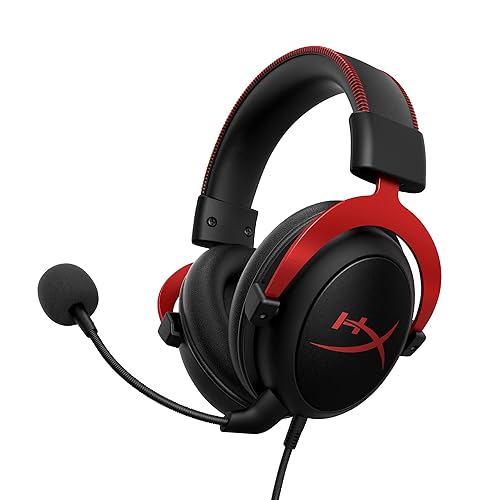
The HyperX Cloud II has been the default first headset for a decade because it is comfortable, wired, and its boom mic is good enough to save a stream when your real mic dies.

The BlackShark V2 is the closest thing to a monitoring headphone that still has a boom on it, at a gaming-headset price.
Open-back, with one warning
Open-back headphones are the most comfortable thing you can wear for hours and they image beautifully, but they leak. Wear them next to a condenser mic and the stream hears your game audio a second time, thin and tinny, through the mic. Pair open-backs with a dynamic mic like the FIFINE or a Shure SM7B, both of which reject sound from behind them, or keep them for editing and use closed-backs live.

Made in Germany, replaceable pads, and the open-back sound that makes long sessions easy on the ears. Pair with a dynamic mic.
Frequently asked
Should I use my headset mic to stream?
Only as a backup. A boom mic sits close to your mouth but also close to your keyboard and your breathing, and it cannot be positioned. A USB dynamic mic on a cheap arm sounds better for less than a premium headset costs.
Are open-back headphones good for streaming?
Comfortable, but they leak sound into your microphone. They work with a dynamic mic that rejects sound from behind, and they are a bad idea next to a condenser.
Is a wireless headset bad for streaming latency?
A 2.4 GHz dongle headset has no noticeable monitoring delay. Bluetooth does, often 100 to 200 milliseconds, which makes hearing your own voice unpleasant. Buy the one with the dongle.
About this guide. Written by Elan Harpaz. We do not lab-test hardware. Every quality verdict on this page is a planning budget computed from a published model, and every price is a tracked estimate rather than a live one. How the numbers are derived: methodology. How picks are chosen: editorial policy.
Build on this in the configurator