The cheapest way to stream from a phone without dropping to BRB
By Elan Harpaz · Updated 2026-08-06
A phone, a gimbal, and a battery. The lowest-cost setup that holds a stable 1080p30, and an honest account of what the first $171 buys over going live for free.
Your connection budget caps you here. More bonded uplink unlocks the next tier without BRB drops. H.265 stretches your uplink further.
Buy links are affiliate links: we earn a commission at no extra cost to you. Prices are tracked estimates, not live prices. Full disclosure
| Component | Pick | Price | |
|---|---|---|---|
| Camera | iPhone 13 Still a great IRL cam. Clean 4K and solid stabilization, runs the Moblin encoder app fine. Find on Amazon | – | Find on Amazon |
| Encoder | Moblin (iOS) Free app encoder with SRTLA bonding straight to a relay. The cheapest real path on iPhone. Learn more | Free | Learn more |
| Data Plan | Visible Unlimited Truly unlimited data on the Verizon network. The IRL favorite for a cheap single line. Learn more | ~$25/mo | Learn more |
| Mount / Stabilizer | DJI Osmo Mobile 6 Proven phone gimbal for smooth handheld footage with a built-in extension rod. Buy on Amazon | $99.99 | Buy on Amazon |
| Power Bank / Portable Battery | ELECOM NESTOUT 10K Rugged, water-resistant bank sized for a phone build that lives outdoors. Buy on Amazon | $54.99 | Buy on Amazon |
| Chat Phone | Phone wrist strap Straps a chat phone to your wrist so you can read chat on the move. Buy on Amazon | $16.99 | Buy on Amazon |
The cheapest stream is the one built on the phone in your pocket, because that phone is already three of the four things a stream needs: the camera, the encoder, and the modem. The fourth is a data plan you are probably already paying for. Everything below is about what the first $171 buys once you have gone live for nothing.
| Free | This build | |
|---|---|---|
| Camera and encoder | Your phone + Moblin (free) | Your phone + Moblin (free) |
| Data | The plan you already pay for | Visible unlimited, tracked at $25/mo |
| Held in frame by | Your arm | Osmo Mobile 6 gimbal, tracked at $109 |
| Runs for | Until the phone battery goes | NESTOUT 10K, 37 Wh, tracked at $47 |
| Reading chat | Not while you are filming | Wrist strap, tracked at $15 |
| Hardware cost | $0 | $171 |
| Quality verdict | 1080p30 | 1080p30 |
Read the last two rows together, because they are the whole argument of this page. The engine gives both builds the same verdict, since in both cases the phone is the uplink and one phone line is what the plan is budgeted against. The $171 is not buying stream quality. It is buying footage a viewer can watch and a session that outlasts the phone battery.
Why the verdict lands at 1080p30
Moblin encodes H.265, and The H.265 Discount means the same picture goes over the wire at about seventy percent of the H.264 bitrate, which is what lets a single cellular line carry a 1080p tier at all. What it cannot beat is The 70% Headroom Rule: we plan one phone line at 5 Mbps sustained and spend only 70 percent of it, so the budget is 3,500 kbps. A 1080p60 tier wants 6,000 kbps before the codec discount and about 4,200 after it, which is over budget. 1080p30 fits, so 1080p30 is what the page claims.
What I left out, and why
- A wireless lav mic. On a phone build the mic has to reach the phone that is also encoding, and the cheapest honest answer is to stand closer and stream somewhere quieter until you have a camera worth pairing one to.
- A relay. It is the right call the moment you are walking, and it costs about $10/mo tracked, but it is not part of a $0 test of whether you like streaming at all.
- The DJI Osmo Mobile SE at $52 tracked instead of the Mobile 6 at $109. Both are 3-axis in our catalog; the built-in extension rod on the 6 is what earns the $57, and only if you frame yourself rather than the street.
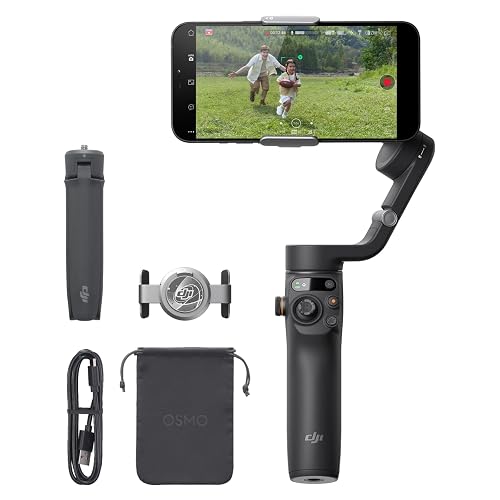
The one part here a viewer sees immediately. Handheld walking footage is the difference between a stream people watch and a stream people close.
Free, encodes H.265, and speaks SRTLA to a relay when you add one. There is no paid app that changes the verdict above.

Water resistant and TSA-legal at 37 Wh, which matters because a phone build lives outdoors and gets on planes.
The upgrade after this one
It is not resolution. A second line on a different carrier, plus something that bonds the two, is the only purchase that changes what happens when you walk into a dead zone. That is the jump from this page to the backpack.
How many connections a tier actually needsThe bitrate-to-bonding mathFrequently asked
What stream quality does this 1080p phone build hold?
This 1080p phone build holds 1080p30 on Twitch (standard), planned against a budget of about 3,500 kbps with the stream itself sitting near 3,150 kbps on the wire. That is a conservative planning figure with headroom built in, not a peak, so it is what the build should hold on an ordinary day rather than its best ever result.
How much upload speed does this 1080p phone build need?
About 4.5 Mbps of sustained upload to run 1080p30 comfortably. That is the 3,150 kbps this build actually puts on the wire plus the headroom that stops a bitrate spike or a moment of packet loss from turning into a buffer. Planning at exactly the stream bitrate is how streams end up stuttering on connections that look fine on a speed test.
How much does this 1080p phone build cost?
$171.97 in hardware as specified here, plus roughly $25 a month in running costs for the data plan, bonding, or relay this build depends on. Prices are tracked estimates rather than a live feed, so treat them as a planning number and check the retailer page before buying.
What is the bottleneck in this build?
What stops this build going a tier higher is the connection. More bonded uplink, or a second carrier, is what unlocks the next tier here, and no camera upgrade will do it. Naming the actual limit matters because the expensive upgrade people reach for first is usually not it.
How much mobile data does this 1080p phone build use per hour?
Roughly 1.4 GB per hour at 3,150 kbps, so a four hour stream is about 6 GB. That number, rather than the price, is what decides which mobile plan works, because it sets how fast you reach the point where a carrier starts deprioritising your traffic.
About this guide. Written by Elan Harpaz. We do not lab-test hardware. Every quality verdict on this page is a planning budget computed from a published model, and every price is a tracked estimate rather than a live one. How the numbers are derived: methodology. How picks are chosen: editorial policy.
Build on this in the configurator