The best Stream Deck for streaming, and whether you need one at all
By Elan Harpaz · Published 2026-08-11
Three decks, priced per key, and the free alternative that does the same job for anyone not switching scenes yet.
Your encoder tops out at 1080p60. A higher-end encoder would go further.
Buy links are affiliate links: we earn a commission at no extra cost to you. Prices are tracked estimates, not live prices. Full disclosure
| Component | Pick | Price | |
|---|---|---|---|
| Camera | Logitech MX Brio 4K Sharp 4K webcam with strong low light. The premium plug-and-play pick. Buy on Amazon | $199.99 | Buy on Amazon |
| Audio | FIFINE USB/XLR Dynamic Hugely popular budget dynamic that rejects room noise and keyboard clatter. Buy on Amazon | $44.99 | Buy on Amazon |
| Control Deck | Elgato Stream Deck MK.2 15 LCD macro keys for scenes, alerts, mutes, and clips. The creator standard. Buy on Amazon | $129.99 | Buy on Amazon |
| Software | OBS Studio Free, open-source broadcast software. On a PC it is also your encoder, up to 4K with a decent GPU. Learn more | Free | Learn more |
A control deck does not make your stream look better, sound better, or hold a higher tier. It is the only part in a desk build that buys nothing except your attention back, which is worth stating plainly before the prices, because the alternative to buying one is free and works.
| Deck | Tracked price | Controls | Cost per control | Also has |
|---|---|---|---|---|
| Stream Deck Mini | $80 | 6 LCD keys | About $13 | Nothing |
| Stream Deck MK.2 | $108 | 15 LCD keys | About $7 | Swappable faceplate |
| Stream Deck + | $200 | 8 keys + 4 dials | About $17 | A touch strip |
The Mini is the expensive one
That is the counterintuitive result in the table and it holds up in use. Six keys sounds like plenty until you lay out what a running stream actually needs: a scene, a second scene, a BRB, a mute, a clip button, a light toggle. That is six, and you have no room left for the thing you think of in week three. The MK.2 costs $28 more and gives you nine spare keys at half the price each.

The pick at $108 tracked. Fifteen keys is the size where you stop rationing them.
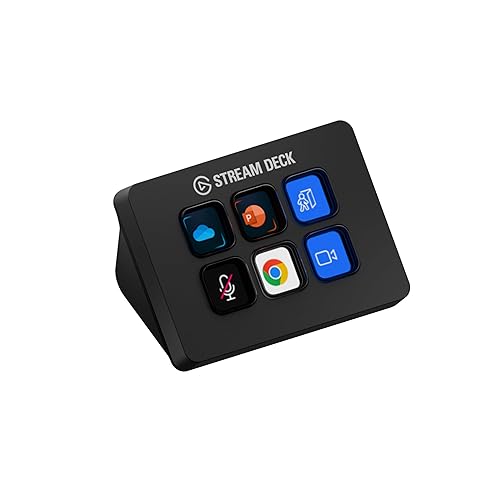
Only when desk space is the binding constraint. On price alone it loses to the MK.2 per key.
What the dials are actually for
The Stream Deck + swaps seven keys for four rotary dials, which is a good trade only if you have something continuous to adjust: a music bed you ride against your voice, a mic level you nudge, a light you dim. A key is binary and a dial is not, so the question is whether anything in your stream needs a value rather than a state. For most solo streamers the answer is no, and $92 more for four dials and seven fewer keys is the wrong direction.
The free version, honestly
OBS binds every one of these functions to a keyboard shortcut at no cost. The real difference is not capability, it is that a labelled physical key is findable by feel when you are already talking and something has gone wrong, and a keyboard shortcut is a thing you have to remember correctly under pressure. Elgato also sells a phone app that puts the same buttons on a touchscreen, which solves the memory problem and not the finding-it-by-feel one.
Frequently asked
Is a Stream Deck worth it for streaming?
It buys you one thing: a control you can hit without looking, while something is already going wrong on screen. Every function on it is available as a free OBS hotkey, so the honest answer is that it is worth it once you are switching often enough that hunting for a key combination is itself the problem.
Which Stream Deck should a beginner buy?
The MK.2 at $108 tracked. It is $28 more than the six-key Mini and costs about $7 per key against the Mini’s $13, so the larger deck is the cheaper one per control. Buy the Mini only when desk space, not budget, is the constraint.
About this guide. Written by Elan Harpaz. We do not lab-test hardware. Every quality verdict on this page is a planning budget computed from a published model, and every price is a tracked estimate rather than a live one. How the numbers are derived: methodology. How picks are chosen: editorial policy.
Build on this in the configurator